Minor Arcana · Pentacles · Number 9
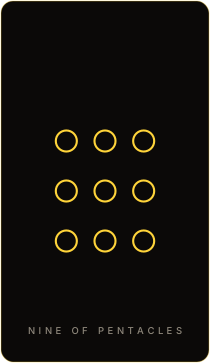
Nine of Pentacles
The dividend of the long discipline — the garden that traces back through the bench, the vine, and the seed. Independence that can't be repossessed. Solitude with a full table. The remaining skill is the strange one: actually walking the rows, actually tasting it.
earned ease, the garden your own, the falcon hooded and kept, solitude chosen not sentenced, the snail's pace honored, walking the rows you planted
Upright
Nine of Pentacles upright meaning
The Nine of Pentacles is the suit's long argument arriving at its proof: this garden is the Ace's coin, planted; the Seven's vine, wisely kept; the Eight's ten thousand carvings, compounded. The woman stands in ease that has a paper trail — and the card insists on the provenance, because it changes everything about the picture. Given ease is a circumstance; earned ease is a property of the person, and it cannot be repossessed. She could lose the vineyard to weather or war and she would build another, because the vineyard was never the asset. The asset is the one walking in it: the judgment, the discipline, the trained hands, the demonstrated capacity to turn seasons into structure. That is the specific flavor of this card's security, and it is the only kind this suit fully trusts.
The falcon is the card's biography, worn on the wrist. A falcon is appetite with wings — impulse, hunger, the part that wants to chase every small bright thing that moves — and hers is neither caged nor released but trained: hooded when it is time for stillness, flown when it is time to hunt, returning to the glove. Every garden like this one was paid for by exactly that bird. The purchases not made, the evenings at the bench, the fast bright chances declined because the vine needed a decade — discipline, the card says, is not the murder of the wild thing; it is its education, and the falconer's reward is that she keeps both: the wildness and the harvest. The snail at her hem is the same sentence at the other speed — even here, in the finished garden, the emblem of slowness is welcome on the path, because the pace was never the enemy. The pace was the method.
And the solitude — the card's most modern nerve. She is alone, and the aloneness is upholstered: not the Five's exile in the snow, not the Hermit's working retreat, but the specific, cultivated pleasure of one's own company in one's own place — the table set for one with the good dishes, the trip taken solo and unhurried, the evening that requires nobody's agreement to be spent exactly as wished. The card arrives, often, to bless an independence someone has been apologizing for — the life built self-sufficient being treated, by the anxious chorus, as a waiting room for real life. The Nine's correction is complete: this is not the absence of the banquet. It is one.
Its counsel is the strangest in the suit, and the builders who most resist it need it most: learn to walk the rows. There is a species of gardener who can plant, tend, defend, and expand a garden and cannot, to save their life, sit in it — the ease always deferred one more season, the enjoying postponed as if it were a luxury the discipline hadn't yet earned, when it is in fact the entire point of the discipline. Taste the grapes, this card orders, gently, this year — walk the vineyard not as its auditor but as its resident; spend some of what was saved on something with no yield but delight; let the falcon off the glove some golden afternoon just to watch it fly. The garden was never the finish line. It was the place being prepared, all along, for a life — yours, the one available now, between these particular vines.
At work
The independence with a paper trail — what you built can be lost; what built it can't be repossessed. And take the dividend: one indulgence with no yield but delight, this quarter, on purpose.
In love
Solitude with the good dishes is a banquet, not a waiting room — stop apologizing for the self-sufficient life. Whoever joins it should add to a garden, not rescue a vacancy.
In you
The falcon stays — discipline didn't kill the wild thing, it educated it, and you get to keep both. Fly it sometimes. The hood is a tool, not a habitat.
Note: Not luck and not inheritance — nine coins of provenance. And not loneliness: read the difference in the posture. Nothing in this card is waiting for somebody.
Reversed
Nine of Pentacles reversed meaning
The garden inverted into enclosure — luxury leased from someone else's approval, the golden-handcuffs post, comfort defended until it became the jailer. Or the builder who audits and never tastes. Check the gate's key and the falcon's wings: whose name is on them?
Reversed, the Nine of Pentacles keeps every grape and loses the freedom that made them sweet — and its first face is the golden cage, whose bars are made of exactly the good things: the salary too high to leave, the lifestyle that annexed every raise, the relationship whose comfort is real and whose price is the self, the beautiful house that decides, now, what work may be considered. The diagnostic is the daydream test: when the thought of leaving arrives — the smaller life, the riskier work, the honest conversation — what answers it? If the answer is a list of what would be lost rather than what would be wrong, the garden has become the argument against the gardener. Comfort was supposed to be the dividend of freedom. Somewhere it changed jobs and became freedom's replacement, and the exchange rate is always eventually regretted.
The second face reads the provenance and finds another name on it: ease that was never self-made. The lifestyle funded by the partner, the parents, the position — pleasant, real, and revocable by someone else's signature. The card does not moralize about this; arrangements are various and some are honest. It only insists on accurate accounting, because the upright Nine's whole security was that her garden could not be repossessed, and this one can: the falcon on the glove belongs to the estate. The homework is not necessarily to leave the garden — it is to own something in it: the skill kept sharp, the account in one's own name, the credential maintained, the answer to the cold question if this ended Tuesday, what is mine? A garden enjoyed is lovely. A garden one could not survive being expelled from is a hostage situation with landscaping.
The third face is the auditor: the builder who got the garden and never entered it. The walls went up for security and kept rising on momentum; the ledger replaced the walking; the grapes are counted annually and tasted never; and the solitude, which upright was a chosen banquet, has quietly become a default — guests unthinkable now, the gate rusted in its habit. This is the saddest inversion because nothing external is wrong: the wealth is real, earned, present, and entirely unconverted into life. The falcon hooded for years is the card's sharpest image here — discipline that was supposed to be a tool has become the permanent weather, and the bird that no longer remembers the sky is not trained. It is broken, politely.
The counsel for all three is the same first motion: test the gate. Literally, in whatever form the literal takes — price the smaller life and discover it is survivable; open the account, update the credential, take the meeting; invite someone in, this month, past the walls; unhood the falcon for one afternoon of unprofitable joy. Cages of this quality are almost never locked from outside — that is the reversal's final, humiliating mercy. The key has been on the inside ledge the whole time, next to the ledger. The garden is still good. It is asking to go back to being what it was for.
At work
The salary too high to leave is a number, so price the alternative: the smaller life is usually survivable, and knowing that reopens the gate even if you stay.
In love
Comfort that answers every doubt with a list of what you'd lose — not what would be wrong — has changed jobs on you. Name what's yours if it ended Tuesday; then choose freely.
In you
Counting the grapes annually, tasting them never — the walls went up for security and kept rising on momentum. Invite someone past them this month. The gate is rusted, not locked.
Note: Not wealth's fault — the grapes are innocent; check the key's name instead. And not solved by burning the garden: cages this good open from inside. The ledge, next to the ledger.