Minor Arcana · Pentacles · Number 10
Ten of Pentacles
The long game completed past one lifetime — family, house, name, the security that has become architecture. Wealth so structural it's invisible to those inside it. Legacy's price is anonymity within your own result. Decide what crosses the arch; everything you live is inherited.
the house with a name, wealth become architecture, three generations under one arch, the invisible founder, what crosses to the grandchildren, games longer than a lifetime
Upright
Ten of Pentacles upright meaning
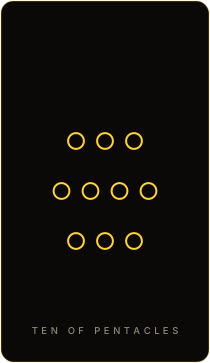
The Ten of Pentacles is what the suit has been building since a hand held out one coin, and its scale has quietly changed: the Nine was a garden with one woman in it; the Ten is walls, an arch, a banner with a name, dogs whose grandparents were also these dogs — wealth that has stopped being money and become architecture. Nobody in this card is doing anything financial. They are talking, playing, sitting: living inside a structure so successful it has disappeared. That is the meaning of the ten coins hanging in the air in their old pattern, visible to the reader and to no one in the scene — security, at this depth, is the water the family swims in, unnoticed precisely because it never fails. The card arrives when a reading touches the long structures: family, property, institutions, the name, the question of what all the earning was ultimately for.
Its most piercing figure is the old man, and the card spends him carefully: he built this — the robe says so, embroidered with the whole suit's symbols — and no one in the scene sees him except the dogs. This is not neglect; it is the physics of finished legacy, and the card refuses to soften it: what you build in this suit's endgame, you build for people who will live in it as weather — unastonished, incurious, safe. The child tugging the dog's tail is the founder's dividend, and the founder is anonymous inside his own result. The Ten calls this success, and means it. There is a species of accomplishment that can only be verified by your own irrelevance to it: the company that runs without you, the children raised so well they don't need you, the tree whose shade you planted for sitters you will never meet. If being thanked is a requirement, stop at the Nine. The Ten is for players of games longer than a lifetime.
And the arch transmits everything — this is the card's second, heavier teaching. Money crosses it, and so does everything else the household lives: the rituals and the recipes, the work ethic and the anxiety, the way conflict is handled and the way it is avoided, the sentences said at dinner about money, strangers, and the self. Inheritance is not a document; it is the total transfer of a family's operating system, made mostly in ordinary moments, mostly unaudited. The Ten's counsel is the audit: you are currently transmitting — everyone with a child, a protégé, a junior colleague, an audience is — and the only choice available is between conscious and unconscious transmission. Walk the estate and inventory the cargo: this crosses the arch on purpose; this stops with me.
The counsel for the builder is patience with the invisible: contribute to walls you won't see finished — the pension, yes, and the institution, the archive, the orchard, the family repaired one honest conversation at a time. And the counsel for the resident is a single act of sight: notice the water. Somebody built the safety you think of as normal; some of them are still alive, sitting slightly outside the scene, attended by dogs. The Ten of Pentacles, at full depth, is the suit saying what it has meant all along: the coins were never the point. The point was this ordinary afternoon, inside walls that hold, with the generations talking under an arch — and someone, today, choosing carefully what to hand through it.
At work
Build what runs without you — the system, the institution, the successor. Verification of this card's success is your own dispensability, and it's the compliment, not the insult.
In love
The arch transmits everything, not just assets: conflict styles, money sentences, the family's whole operating system. Audit the cargo — "this crosses on purpose; this stops with me."
In you
Notice the water: somebody built the safety you experience as normal. Some of them are still in the scene, unnoticed, near the dogs. One act of sight is the whole homework.
Note: Not just money — a Ten this size is structure: name, walls, ritual, weather. And not cold: the child and the dog are the dividend. It was always for the ordinary afternoon.
Reversed
Ten of Pentacles reversed meaning
The structure turned constrictor — the will that split the siblings, the money that votes on your life, the name that pre-wrote the future, the family pattern shipping to the next generation unopened. Walls this old keep in as well as out. Untangle the money from the love; choose what to carry.
Reversed, the Ten of Pentacles is the estate with its costs showing, and the first cost is the oldest story in property: the inheritance that divides. Money that meant love while the founder lived becomes, at the reading of the will, a measure of love — who got the house, whose share tells them what they were worth — and siblings who shared childhoods discover they cannot share an estate. The card's counsel here is unsentimental, because the stakes are relationships that predate the money and should outlast it: separate the ledgers. Explicit wills, spoken intentions before death, the discount for the caretaking sibling discussed in daylight — every ambiguity in an estate is a deferred conflict with compound interest, and clarity, which feels cold at the family dinner, is the warmest thing anyone can put in writing. When the split has already happened: decide early what the relationship is worth in currency, because that is the actual exchange rate of every estate fight — how many siblings is this house worth? The answer has never once been one.
The second face is the name as harness: the inheritance that arrives with a life pre-attached. The family firm awaiting its reluctant heir, the fourth-generation profession, the money that pays the tuition and picks the degree, the approval disbursed like a trust — conditional, reviewable, revocable. This is the Six of Pentacles' strings grown to estate scale, and the diagnostic is the same one the golden cage taught: when you imagine the disinherited life — the smaller apartment, the unblessed career, the partner they wouldn't choose — is the fear about what would be wrong, or only about what would be withdrawn? The heirs who thrive are those who priced the exit and then chose — stayed or left, but on purpose, converting the harness back into a coat that can be taken off. An inheritance you cannot afford to decline is not an asset. It is an employer, with unusual holidays.
The third face is the heaviest cargo: what crosses the arch unexamined. Estates transmit their dysfunctions with the same efficiency as their assets — the alcoholism and the silence about it, the anxiety about scarcity that survives three generations of plenty, the alliances and exiles, the way anger is done here, the way women are spoken to here. The reversal marks the moment someone in the line becomes the arch's inspector: sees the pattern mid-transfer, in themselves usually — hears the parent's sentence exiting their own mouth toward their own child — and has, briefly, jurisdiction. Breaking a generational pattern is this suit's slowest, least witnessed work: no banner, no ceremony, mostly the unglamorous repetitions of doing it differently under pressure, the apology the line never made, therapy as estate renovation, the heirloom deliberately not passed on. The card ranks it with its highest acts, and the physics is the founder's own — the beneficiaries will live in the result as weather, unastonished, never knowing it was ever otherwise. The child at the gate will tug the dog's tail inside whatever you decide crosses. That anonymous, structural, entirely unthanked gift — the harm that stops with you — is the reversed Ten's version of building, and it counts. The walls, examined honestly, were never the family. The people under the arch were. Renovate accordingly.
At work
The firm awaiting its reluctant heir — price the exit before choosing. An inheritance you can't afford to decline is an employer, not an asset. Stayed-on-purpose reads different from trapped.
In love
"How many siblings is this house worth?" — the answer has never been one. Explicit wills, daylight conversations; clarity feels cold and is the warmest thing anyone puts in writing.
In you
You caught the pattern mid-transfer — the parent's sentence in your own mouth. That's jurisdiction, briefly. What stops with you is a structural, unthanked gift, and it counts as building.
Note: Not the family — the walls; don't confuse defending one with keeping the other. And not automatic: nothing crosses the arch without a carrier. Every transmission has hands on it, this year, yours.