Minor Arcana · Pentacles · Number 4
Four of Pentacles
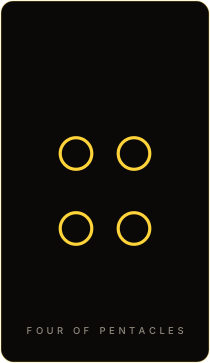
The holding pattern — money saved, boundaries kept, control established, often after real scarcity. Nothing here is lost; nothing here moves. Count the limbs: all four are employed in defense. Safety is real, and it is currently the only thing being produced.
security achieved and over-defended, every limb employed in holding, the crown that carries instead of thinks, saving grown into hoarding, the city at his back, safe and a little stuck
Upright
Four of Pentacles upright meaning
The Four of Pentacles is routinely read as the miser, and the reading is too easy — because the first honest thing about this card is that the coins are real and were probably hard-won. Somebody saved this. The card often arrives after chaos: the debt cleared, the emergency fund finally funded, the boundaries installed after years without any, the life consolidated into something that cannot be taken by one bad month. Earth is the suit of security, and the Four is security achieved — a legitimate season, sometimes a medically necessary one. The deck does not sneer at the person holding tight. It just asks them, gently, to conduct one audit: the posture.
Count the limbs. Two arms around the coin at the chest. Two feet pinning the coins on the ground. The crown — the deck's symbol for sovereign thought — repurposed as a shelf. The audit's finding is arithmetic, not moral: every limb this man owns is employed in holding, which means the holding is no longer something he does; it is everything he does. He cannot shake a hand, accept a gift, build, gesture, or walk, and he cannot think freely with the head balancing an asset. This is the card's precise definition of the line between saving and hoarding, and it has nothing to do with the amount: saving is when the coins serve the life. Hoarding is when the life staffs the coins.
And the grip, once learned, generalizes — this is the card's quiet second act. The hands that learned to hold money this way begin holding everything in the same fist: the schedule defended to the minute, the relationship monitored like an account, the grudge maintained because releasing it feels like a loss, the opinions kept past their sell-by because changing one's mind reads as theft. Underneath, almost always, is a scarcity memory outliving its facts — the lean year, the precarious childhood, the betrayal — still setting the grip strength decades after the circumstances changed. The fear was calibrated once, honestly, to a real famine. Nobody told the hands the famine ended.
The counsel is not release — telling this card to open all four limbs at once is both useless and unkind. It is one limb. Choose the cheapest coin — the smallest held thing whose holding costs most: the standing invitation always declined, the tenner that would tip generously, the apology withheld like capital — and free the single limb that holds it. Watch what happens, which is, reliably, nothing bad; the sky's failure to fall is the only argument the old fear accepts, and it accepts it slowly, at the rate of one opened hand at a time. The city, remember, is behind him — the whole card's geometry says it: he faces away from every person he is guarding the coins for or against. Security was supposed to buy a seat at that table. Spend one coin on the seat.
At work
Consolidation was the right season — but audit the posture: if every hour is spent defending what exists, nothing new is being built. Free one limb; delegate one held thing.
In love
The relationship monitored like an account, affection released in fixed installments — the grip learned on money generalizes. One opened hand, and watch the sky not fall.
In you
The scarcity was real once; check the date on it. Fear calibrated to an old famine is setting today's grip strength. Nobody told the hands it ended.
Note: Not greed as caricature — this is defense, usually with an honest origin story. And not wrong to have saved: the coins serve the life or the life staffs the coins. That's the whole test.
Reversed
Four of Pentacles reversed meaning
The fist opening — by choice: generosity, the first real spending on life, control finally lent out. Or by force: the loss that pried the fingers back. Or the swing: hoard to splurge with no stop between. The question is the same in all three — who is deciding the grip now?
Reversed, the Four of Pentacles is the grip changing, and the card is scrupulously neutral about direction — for better or worse is the honest motto, because open describes both a gift and a robbery. The reading turns on one question: did the fingers open, or were they opened?
The better version is one of the suit's quiet victories, easy to miss because it looks like small transactions: the man on the bench sets down one coin and does something with the freed hand. Picks up a dinner bill. Funds the course. Says take the car. Delegates — actually delegates, without the shadow audit afterward. Lets the partner see the accounts; lets the friend see the fear. In relationships, this is control lent out at interest: the discovery, staggering to the long-clenched, that trust placed in a competent other returns more security than it cost, because two watchers sleep better than one clencher. The reversal at its best is not the opposite of the Four's caution; it is caution graduating — the realization that a fortress is only worth holding if the drawbridge sometimes comes down, and that the coins, pinned underfoot all those years, were not appreciating. They were just dark.
The worse version arrives uninvited: the market turn, the diagnosis, the redundancy, the theft — life prying the fingers back one by one, taking a coin the grip had organized itself around. The pain here is double, and the card is honest about both layers: the loss itself, and the identity that held it. The clencher discovers that the holding had become the self, and with a coin gone he does not know his own posture. What the reversal offers this face is cold but real: the hands are open now. It was not chosen; it is still true; and open hands, whatever opened them, are the only kind that can receive. Most stories of unexpected help, second acts, and strangers' kindness begin exactly here — at the bench, palms up, involuntarily available at last.
And there is the third face, which the card watches with something like clinical interest: the swing. The lifelong clench that fails not into openness but into spray — the hoarder become spendthrift overnight, the decade of denial converted into one catastrophic season of yes to everything. This is not liberation, and the card is firm about why: it is the same disorder at the other amplitude. The clench and the splurge share a root — a grip that has never learned pressure, only position; a person for whom money has never been a tool, only a feeling to be either suppressed or discharged. The counsel for all three faces converges on the same discipline: chosen pressure. Open by decision, at a rate — one coin, one trust, one drawbridge at a time, with the hand's owner, not the old fear and not the new giddiness, setting the grip. The Four upright asked whose life the coins serve. The reversal asks the harder follow-up: whose hand is this, and it is answered — this suit never tires of saying it — not once, but every time the fingers move.
At work
Delegation without the shadow audit — control lent to a competent other returns more security than it cost. If loss forced the opening: palms up is also how help arrives.
In love
The drawbridge down at a chosen rate: let them see the accounts, then the fear. Two watchers sleep better than one clencher.
In you
Watch the swing — hoard to splurge is the same disorder at the other amplitude. The skill was never clench or release; it's pressure, chosen, each time the fingers move.
Note: Not loss by definition — half these openings are graduations. And not liberation if it's spray: yes-to-everything is the old fist discharging, still nobody's hand.