Minor Arcana · Pentacles · Number 3
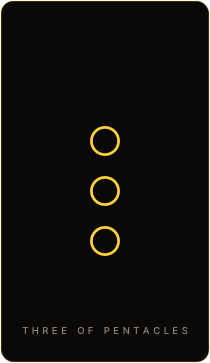
Three of Pentacles
Collaboration doing what solitude can't — skill, design, and purpose at one table, the work reviewed and the reviewer welcome. Competence getting noticed early. Build the joints between people as carefully as the stone; cathedrals are made of both.
the work bigger than one pair of hands, craft meeting plan meeting purpose, the apprentice consulted, review as honor, cathedral time, joints between people
Upright
Three of Pentacles upright meaning
The Three of Pentacles is the suit's first crowd scene, and its cast is chosen with care: a mason, who knows how stone actually behaves; an architect, who holds the drawings; a monk, who represents what the building is for. Skill, design, purpose — three authorities that in most workplaces orbit each other with polite mutual contempt — are here at one table, and the card's radical detail is the direction of attention: the two senior figures are consulting the junior one. The mason has stopped carving to say something about the actual stone, and the people with the plans and the robes are listening. Wherever this card lands, work has reached the stage where it cannot advance alone: the craft needs the plan, the plan needs the purpose, and all three need the meeting.
The card's setting is its quiet philosophy. A cathedral is the type specimen of a particular kind of work: too large for one lifetime's hands, begun by people who would not see it finished, held together not by any single genius but by the quality of ten thousand joints — stone to stone, and worker to worker. The Three's claim is that the second kind of joint decides the first. Work done in proud silos produces walls that meet at angles nobody checked; work that passes through honest conference — the drawing questioned, the constraint surfaced, the correction received without wounded ego — produces the vault that holds for six centuries. Collaboration, in other words, is not the soft skill next to the real one. In anything bigger than a bench, it is the load-bearing craft.
There is also a smaller, warmer card inside the big one, and for many readers it is the live wire: the apprentice consulted. This is the moment a person's competence is first taken seriously by the institution — invited to the meeting that used to happen without them, asked what do you think by someone who signs things. The Three's counsel here is direct: when the plans are opened toward you, speak to them. Not deferentially, not grandly — accurately, from the stone you actually know. Careers in this suit are built at exactly this joint, and the mason who says the arch wants a deeper course here, and can show why, has done more for his future than a year of quiet excellence performed for nobody.
The working counsel is joint maintenance, three practices. Show unfinished work — the review that stings for a minute saves the wall that would have failed in a year, and the craftsman who hides work until it is perfect is protecting ego, not quality. Ask what the building is for — teams misalign not at the level of effort but at the level of purpose, and the monk's question, asked plainly in the meeting (what is this actually in service of?), re-squares more walls than any process document. And honor the other trades: the plan-holder and the purpose-keeper know things the chisel cannot, exactly as the chisel knows things the drawings miss. The three pentacles overhead are already carved. That is the card's promise about work joined this way: it outlasts everyone at the table, which was, all along, the point of tables.
At work
The meeting where skill, plan, and purpose actually confer — when the drawings open toward you, speak from the stone you know. Show unfinished work; the early sting saves the wall.
In love
Building as a pair or family is a trade with joints — the review received without wounded ego, the "what are we actually building" asked out loud. Angles nobody checks don't meet.
In you
Competence just got noticed — the invitation to the table is real, so occupy it accurately, neither deferential nor grand. A year of quiet excellence performed for nobody builds nothing.
Note: Not committee for its own sake — three authorities, each with real jurisdiction, is the number. And not the finished cathedral: this card is scaffolding weather. The vault comes from keeping the meeting honest.
Reversed
Three of Pentacles reversed meaning
The collaboration failing quietly — same site, same logo, separate buildings. Feedback dodged, the expert overruled by the org chart, the flaw everyone sees and no one raises. Nothing is on fire; the angles just don't meet. Reconvene at the drawings before the vault does the announcing.
Reversed, the Three of Pentacles is not the building falling down — that would at least force a meeting. It is the quieter failure state of shared work: everyone still on site, everyone still skilled, and no one pulling the same way. The mason carves to last month's measurements; the architect has revised the drawings and told half the people; the monk has stopped attending because the meetings stopped mentioning what the building is for. The org chart looks like a team. The work, examined closely, is three private projects wearing one logo — and the card's chill detail is how long this can run before anything visibly breaks, because skilled people can compensate for missing alignment right up until the day the walls are supposed to meet.
The failure has a taxonomy, and honest teams will recognize their species. There is the avoided review — work hidden until "ready," which means until criticism would be too expensive to act on; feedback economies where the true sentence (this course is off) costs the speaker more than the silence costs the building. There is the overruled chisel — the person who actually knows the stone talked past by the person who owns the drawings, expertise losing to hierarchy in every collision, until the expert stops offering and starts merely complying, which every veteran of this reversal knows is the moment the real information leaves the room. And there is the politest species: mediocrity by consensus — the half-degree error that everyone has seen and no one names, because naming it would implicate the vibe, and the vibe has quietly become the thing the team actually builds and maintains.
What the reversal wants understood is that none of these is a craft problem — the carving, note, is still skillful. They are joint problems, and joints fail silently first. The half-degree in the vault is the card's whole sermon: at the moment of carving, the error is one honest sentence wide; ten courses later it is a rebuild; at the vault it is the story everyone tells afterward about why the project died. The cost of the true sentence rises with every course laid on top of it. Teams do not usually lack the diagnosis — ask anyone privately and they will draw you the half-degree freehand. They lack a place where saying it is safe and normal, which is what the upright card's meeting was.
So the counsel is unglamorous and specific: reconvene at the drawings. Not the retrospective about feelings — the actual plans on the actual table, three questions in the monk's plain style. What are we building — said aloud, because half the divergence began when the purpose went implicit. Where are we each working from — surfacing the three different versions of "current" that everyone believed was shared. And what is the half-degree — the flaw in plain sight, named first by whoever holds the most safety in the room, because rank buys the right to spend it on exactly this. If the meeting cannot be convened — if the drawings' owner will not open them — then the reversal is telling you which project this actually is: not the cathedral, someone's monument. Masons outlive monuments. Take the chisel where the vault is still honest.
At work
Same site, three private projects — reconvene at the actual drawings: what are we building, from which version, and who names the half-degree. Rank spends first; that's what it's for.
In love
The flaw both of you see and neither raises — one sentence wide today, a rebuild in ten courses. The cost of the true sentence only rises. Say it at carving stage.
In you
If your expertise keeps losing to the org chart, watch for the moment you stop offering and start complying — that's when the real information leaves the room. Don't be there for it.
Note: Not a skill deficit — the carving is still good; the joints are failing. And not resolved by working harder in the silo: compensation holds only until the walls are due to meet.