Major Arcana · Number 12
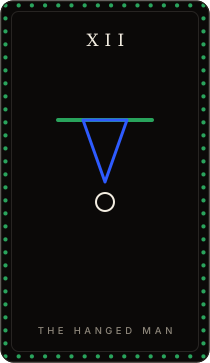
The Hanged Man
Stopping on purpose to see it from the other side. Progress through yielding; the cost accepted in exchange for the new angle. Do not push — reframe. The pause as the most active move available.
suspension, surrender, the reversed view, willing pause, sacrifice that buys sight, progress through yielding
Upright
The Hanged Man upright meaning
Everything you have tried has one thing in common: it was pushing. Harder, smarter, from new angles, with new tools — but pushing. The Hanged Man is the card of the other physics: some knots do not open under tension. They open when the rope goes slack, and the slack has to be given on purpose, by someone strong enough to look like they are doing nothing.
Read the detail that changes the whole card: he climbed up there himself. This is not punishment, capture or defeat, whatever the posture suggests to a hurried eye. It is a chosen suspension — the deliberate purchase of a different vantage at the price of looking foolish, losing time, and hanging in public while others walk by upright and certain. The halo is not decoration. It is what the card thinks of that trade.
Upside down, the world reorganizes. What was urgent sinks to the bottom of the frame; what was background — the person, the detail, the quiet fact you filed away months ago — hangs suddenly at eye level. You do not get this inversion by thinking harder in the standing position. Thinking harder in the standing position is how you got the knot.
There is a surrender in this card, and it is precise: not surrendering the goal, but the grip. The argument you no longer need to win. The timeline you no longer need to control. The version of events you no longer need everyone to accept. Each of these released returns an astonishing amount of energy, which is how you discover how much they were costing to hold.
The pause has a term. That matters. The Hanged Man is a stage, not a residence — the card of days or weeks, not of years. The view gets seen, the sight gets paid for, and then the ankle comes untied and the walking resumes, differently. Suspension that has no intention of ending is a different card, and it is this one turned over.
The question underneath: what would this situation look like if you stopped defending your current view of it for one week?
At work
Do not push — reframe. The project stuck at the level of effort resolves at the level of framing. Pause the sprint; the answer is visible from the other orientation.
In love
Letting go of winning the argument. Hanging inside the discomfort of not being agreed with, and finding the bond survives it — improved.
In you
Stillness as the move. The willing pause with a term on it. Seeing your own situation upside down, halo optional.
Note: Not defeat, not punishment. He climbed up there himself — the surrender is a technique, not a collapse.
Reversed
The Hanged Man reversed meaning
Waiting that is really avoidance. The noble pause gone stale; things given up with the loss rebranded as wisdom. The view has been seen — hanging longer adds nothing. Martyrdom accruing interest it intends to collect.
Reversed, the Hanged Man has outstayed his insight. There was a real pause once, with a real purpose, and it worked — the view was seen, the reframe arrived. But the untying never happened. Somewhere along the way the suspension stopped being a technique and became an address, and "I am reflecting" became the most respectable available translation of "I am afraid to come down."
Check the calendar honestly: how long has this pause lasted, and when did it last produce anything new? Genuine suspension pays out in sight — fresh angles, changed frames, decisions ripening. A pause that has stopped paying is not patience. It is a stall wearing patience's clothes, and the difference is measurable by output, not by how the waiting feels from inside.
The card's second face is the martyrdom ledger. Sacrifice without sight: things given up — comfort, opportunities, years, versions of yourself — with the loss itself presented as the achievement. But renunciation is a purchase, not a virtue; it is only worth what it buys. If what it bought was mainly the identity of the one who gave things up, the transaction wants reviewing. Suffering displayed is not the same as suffering spent well, and the people around you can tell which one they are watching, even when they are too kind to say.
There is a quiet manipulation possible from the rope, and the reversed card names it: the visible sacrifice that accrues moral interest, payable by others in guilt. Devotion performed at this angle is not devotion. It is invoicing.
The hands stay behind the back, and that is the final detail: from where they are, the ankle is reachable. It always was. Nothing external maintains this suspension anymore — no tree, no rope, no circumstance has that kind of budget. The reversed Hanged Man is held up by the holding itself, and comes down the afternoon he decides the view has been sufficiently seen. It has. The ground is closer than the hanging makes it look.
At work
Gathering information as a permanent state. The pause that was strategy in month one and hiding by month six. Decide with what the hanging already taught you.
In love
Suffering displayed as devotion; the sacrifice with an invoice attached. Or waiting for the other person to change as a full-time occupation.
In you
Stuck, rebranded as patient. The loss called wisdom before it bought anything. The ankle within reach of your own hands, and the hands kept busy elsewhere.
Note: Not a demand for action at any cost. The view was real — but it has been seen. Hanging longer adds nothing the first month didn't.