Major Arcana · Number 11
Justice
Outcomes proportionate to actions. The decision made on evidence, not appetite; the account honestly squared. Giving and getting what is actually owed — no more, and no less, which is the harder half.
fairness, cause and effect, truth weighed, accountability, the clear verdict, what is actually owed
Upright
Justice upright meaning
The books balance eventually. Not always on the schedule you would choose, and rarely with ceremony, but this card insists on the arithmetic: what was put in is what comes out, adjusted for time. If something in your life is currently paying out — well or badly — Justice invites you to trace the deposit. It is usually findable, and usually yours.
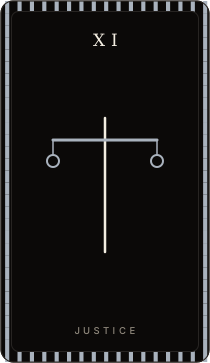
The sword is upright. This matters more than anything else in the image: it is not pointed at a defendant, not swinging, not avenging. An upright blade is a tool for cutting things apart cleanly — the facts from the feelings, the story from the evidence, what happened from what you have been telling people happened. Before any verdict, Justice does separation work, and most situations arrive at her bench still glued together.
Accountability has a precise meaning here, and it runs in both directions. Owning your part means all of it — the contribution you made to the mess, counted honestly. It also means only it. There is a popular counterfeit of responsibility that consists of absorbing everything, apologizing for weather, carrying other people's ledgers as a form of virtue. The scales read that as inaccuracy, not kindness. Your column has a bottom line; theirs does too.
The verdict this card asks of you is usually one you have been avoiding delivering — to someone else, or to yourself. The clear call. The plain sentence that has been sitting fully drafted behind the veil for weeks: this is not fair, or this was my doing, or both, in order. The relief on the other side of an honest verdict is one of the most underrated feelings available, and the card knows you know the sentence already.
One more thing about the level scales: they were not always level. Balance is not a temperament; it is a result — of weighing, discarding, reweighing, at some cost. People who deliver fair judgments cheaply are usually delivering something else. If your call has been slow, that is not necessarily weakness. Some things take exactly as long as they take to weigh.
The question underneath: what would you decide today if you were only allowed to use the evidence?
At work
The audit, the contract, the fair call. Terms stated plainly and honored; credit assigned where the work happened. The negotiation where you ask for the actual number.
In love
Balance kept honestly — not scorekeeping, which is its counterfeit. Owning your part in the pattern, and handing back the parts that were never yours.
In you
The clean verdict on your own conduct: what was yours, what was not, in exact proportion. The excuse retired; the over-apology also retired.
Note: Not revenge. The sword is upright, not swung. Proportion is the entire discipline — getting even is a different card, and it is not in this deck.
Reversed
Justice reversed meaning
The reckoning avoided. A genuine injustice — done to you, or by you — left unaddressed while the interest compounds. The story tilted to keep its narrator comfortable; the excuse working overtime.
Reversed, Justice is an account left open on purpose. Something happened — a wrong done to you, a wrong you did, a bargain that was never fair from the first handshake — and the reckoning it requires keeps being rescheduled. Unsquared accounts do not close themselves. They compound quietly, charging interest in resentment, avoidance, and the low persistent hum of a thing unfinished.
Start with the tilt you can control: the story. Every narrator tilts; that is what narrating is. But there is a degree of tilt past which the story stops being a perspective and becomes a shelter — the version where you are only the weather's victim, or only the innocent party, or where the thing that happened simply is not mentioned, like the object behind the veil. You know which scene your telling skips. The skip is the location of the work.
If the injustice is real and incoming — the unequal terms, the credit taken, the pattern of small unfairnesses tolerated because objecting felt expensive — the card's news is that tolerance has costs too, and they have been accruing. Fairness withheld from you does not become fair through your patience with it. At some point the objection must be filed, calmly, with the sword upright: this is not proportionate, and here is what would be.
If the injustice is yours — and the reversed card asks you to at least check — the mechanism is usually not villainy but bookkeeping: the harm minimized, the context inflated, the apology delivered in a currency easier than the one owed. Repair has an exchange rate, and underpaying it keeps the account open no matter how settled it looks from your side of the table.
The way back is unglamorous: sit down with the ledger. One honest hour, the actual events in order, your column and theirs, no adjectives. The scales do not need you to be good. They need you to weigh — and the moment the weighing restarts, this card turns back over.
At work
Unequal terms tolerated too long; the invoice unsent, the objection unfiled. Or credit quietly taken — check whose name ended up on what.
In love
The imbalance both of you can see and neither will weigh. The apology paid in a cheaper currency than the one owed.
In you
The story tilted to keep you comfortable in it. The excuse doing overtime; the one scene your telling always skips.
Note: Not hopeless. The ledger opens whenever you sit down to it — the scales resume the moment the weighing does.