Minor Arcana · Wands · Number 10
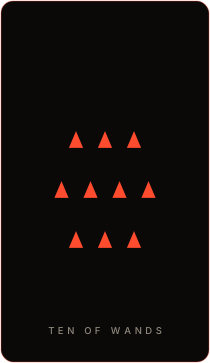
Ten of Wands
Everything won, everything carried — the success that arrived as workload, the responsibility hoarded until it bends the spine. The town is near; the load is real; most of it was picked up voluntarily and can be set down the same way.
the full load, success become burden, over-responsibility, carrying alone, the last stretch bent double, all ten at once
Upright
Ten of Wands upright meaning
The suit of fire ends not in flame but in freight. The Ten of Wands is what happens after every spark catches: the venture funded, the family grown, the reputation earned — and all of it, somehow, riding on one bent back. The card's cruelest detail is its kindest insight: no one is attacking this man. The Five's rivals, the Seven's besiegers, the Nine's approaching threat — all gone. What remains is only what he said yes to. The Ten is the card of success experienced as weight, and its first question is disarmingly literal: who decided you carry all ten?
Look at how he holds them. Not slung across the shoulders, not dragged in a cart, but bundled in front of the chest — the one grip that blocks the carrier's own eyes. This is over-responsibility's exact posture: the load held so tightly, so personally, that it becomes the entire field of vision. He can no longer see the town he is walking toward, the road he is on, or — the card's quiet joke — the fact that ten wands make a raft, a fence, a frame, anything but a burden, if they ever touch the ground again. Carried this way, even assets become blindfold.
The essay under the image is about a confusion the capable are prone to: mistaking load-bearing for love, or for worth. Somewhere back down the road, being the one who carries became the identity — and identities are the one luggage nobody audits. So the wands accreted: the task kept because delegating felt like betrayal, the obligation absorbed because someone had to, the standard maintained because you always have. Each yes was reasonable. The bundle is not. The Ten does not ask whether you can carry it — obviously you can, you are — it asks what the carrying is displacing: the view, the pace, the hands that could hold anything else.
And still: the town is close. This card is genuinely near its end, and sometimes the honest reading is simply finish the haul — deliver the load, complete the season, and then renegotiate everything before the next bundle forms. The Ten permits that. What it does not permit is the disguise: calling permanent what was supposed to be a stretch, calling virtue what is only habit. Set down what you can now. Deliver what you must. And decide — in daylight, before the next yes — which of these wands were ever actually yours.
At work
Success arrived as workload — every project yours, delegation felt as betrayal. Finish the delivery, then audit the bundle: half these wands have other owners.
In love
Carrying the relationship's whole logistics and calling it devotion. The load blocks the view of the person. Hand over wands; being helped is intimacy too.
In you
Load-bearing mistaken for worth. You can carry it — that was never the question. What is the carrying displacing? The town is close; renegotiate after delivery.
Note: Not punishment and not attack — nothing in the frame is hostile. A pile of voluntary yeses. What was picked up can be put down.
Reversed
Ten of Wands reversed meaning
The load released — by choice, by delegation, or by collapse. Burnout named, the yes revoked, the bundle finally audited. Lightness with a lesson in it: which wands go back in the arms, and which never do.
Reversed, the Ten of Wands is the bundle on the ground, and everything depends on how it got there. There are two ways down for a load like this — it is set down, or it drops — and the reversed card covers both, gently for one and urgently for the other.
The set-down is the good ending: the delegation finally made, the resignation tendered from strength, the honest sentence — I can't carry this alone anymore — said before it had to be proven. If this is where you are, the card's work is to block the guilt that follows. Putting down wands that were never yours is not abandonment; it is returning stolen goods to their rightful owners, who were often waiting, oddly enough, to be allowed to carry something. Expect the world not to end. That non-ending is the lesson, and it is worth watching closely, because the next bundle will begin recruiting within days and you will want the evidence fresh.
The drop is the other ending: collapse, burnout, the body deciding what the calendar refused to. If the wands scattered rather than being placed, the priority is not to gather them — it is to resist the reflex that is already bending your knees toward the pile. The capable rebuild their burdens with astonishing speed, mostly to escape the discomfort of standing empty-handed. Stand empty-handed a while. Collapse is expensive tuition; the only way it becomes a bargain is if the lesson is actually collected: not "carry better" but "carry less," and not "less for now" but a different architecture entirely — loads shared by design, not by emergency.
Either way, the reversed Ten stages the suit's final scene: a person, ten wands, and a choice made visible at last. Sort the pile in the open. A few of these are load-bearing — yours, truly, worth the spine. Several belong to other people, with names, and can be handed over this week. And some, held up to the light, are nothing but old yeses that outlived their reasons. The fire suit began with one wand full of possibility. It ends here, asking you to pick up — deliberately, this time — only what still is.
At work
Burnout arrived or narrowly dodged — either way, the audit is due. Sort the pile publicly: yours, theirs, expired. Rebuild loads by design, not emergency.
In love
The over-carrier stopped carrying — now the silence where the logistics were. Let the imbalance stay visible; it is the only way it gets renegotiated.
In you
Standing empty-handed and itching to re-bundle. Wait. Collapse's tuition is only worth it if the lesson is "carry less," not "carry better."
Note: Not failure of strength — strength was never in question. And not permission lost: the town is still reachable; it always was, lighter.