Minor Arcana · Wands · Number 7
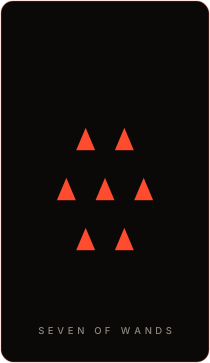
Seven of Wands
Position defended — the idea challenged, the boundary tested, the territory contested after the win. Outnumbered but advantaged: you hold the hill. The question underneath: is this hill the one worth your one wand?
defense of ground, holding position, conviction under pressure, the high ground earned, one against six, advantage in the fight worth having
Upright
Seven of Wands upright meaning
The parade of the Six had a sequel the crowd did not stay for: someone came for the hill. The Seven of Wands is what success costs on the day after — the promotion resented, the thesis attacked, the boundary tested precisely because it was finally drawn. The card's geometry matters more than its mood: one wand against six looks like losing arithmetic, until you notice the defender holds the high ground and the six below must fight uphill, unseen even by each other. Position beats numbers. You are not outmatched. You are merely, at last, worth attacking.
That reframe is the card's first gift. Challenge arrives in proportion to visibility — the unattacked position is usually the unimportant one. If the pushback started when the work got real, the pushback is a compliment wearing bad manners. Read it that way and half its weight lifts: they are not disputing your right to exist; they are disputing territory that is now, evidently, valuable.
The second gift is the mismatched shoes. The defender was not ready — no one is; defense is always improvised, always scheduled by the attacker. The card gives permission to hold ground imperfectly: to defend the idea before the argument is polished, to keep the boundary while your voice shakes, to say "no, this is mine" without footnotes. Conviction is not the absence of wobble. It is staying on the hill while wobbling.
But fire spent on defense is fire not spent on building, and the card knows its own cost. So it asks the only question that separates courage from stubbornness: is this hill the one? Some positions are load-bearing — the value, the standard, the claim your work rests on — and yielding them collapses more than the hill. Others are just where you happened to be standing when challenged, held now out of pride's momentum. Defend the first kind with everything. Walk down from the second kind on purpose, unbeaten, and spend the wand where it builds. The defender's real advantage was never the slope. It was knowing why he was up there.
At work
Your idea under fire after gaining ground — defend the load-bearing claim, imperfectly and out loud. Decline the turf wars that only pride is holding.
In love
The boundary tested because it finally exists. Holding your terms while they wobble. Defending the relationship — or your place in it — against opinions from below the hill.
In you
Conviction under pressure. The standard everyone questions is the one to restate plainly. You were allowed to start defending before you felt ready.
Note: Not paranoia and not losing — the high ground is yours. But not every hill either: some ground is only pride's, and walking down is not defeat.
Reversed
Seven of Wands reversed meaning
The defense past its budget — overwhelmed, exhausted, or aimed at attackers who left. Defensiveness hardened into posture; every question heard as siege. Time to count what the hill still costs and what it still protects.
Reversed, the Seven of Wands is a defense with a broken gauge — either too little left, or aimed at too much. The upright card's question, is this hill worth it, has stopped being asked; the defending has become automatic, and automation is exactly what this card comes to interrupt.
One version is simple depletion. The challenges were real and relentless, and you have held the hill so long that holding is all you do — every email braced for, every meeting entered sideways, the whole self reorganized around the perimeter. Vigilance at that dose stops protecting the thing and starts replacing it: there is a point where the fort contains nothing but the garrison. If that is where you are, the strategic move is not one more swing. It is reinforcement — the ally never called, the fight split into the two that matter and the four that don't — or a considered retreat that trades ground for the ability to keep any ground at all. Retreat, chosen and named, is a maneuver. Collapse is not. The card would rather you walk down than fall down.
The other version is subtler: the attack ended and the defense didn't. Someone challenged you once, sharply, years ago — and every neutral question since has been received as its echo. Feedback triggers the full perimeter response; closeness reads as approach vector; the six wands below the hill are, on honest inspection, mostly memory. Defensiveness as habit has a tell: it fires at uniform intensity regardless of the threat's size. If a colleague's small note and a real betrayal produce the same surge in you, the surge is not information about them. The repair begins with one deliberate act of non-defense — letting a single true criticism land, unanswered, and discovering the hill does not fall.
Both versions end at the same audit: name what the hill actually protects, in one sentence. If the sentence holds — a value, a person, work that matters — then rest, reinforce, and hold smarter. If the sentence will not form, you have been defending a habit of defending. Set the wand down. The men who were coming up the hill left a long time ago.
At work
Every review a siege, every question an attack — or truly outnumbered and unstaffed. Call the ally, drop four of the six fights, or retreat on purpose with terms.
In love
The perimeter response to neutral questions; closeness read as approach vector. Let one true criticism land unanswered. The hill survives it.
In you
Vigilance replacing the thing it guarded. Name what the hill protects in one sentence — if the sentence won't form, the war is memory.
Note: Not proof you were wrong to defend. A gauge failure, not a verdict — the cause may stand even as this way of holding it falls.