Minor Arcana · Swords · Number 9
Nine of Swords
The night-mind at full volume — anxiety, dread, the loop of worst cases rehearsed in the dark. The swords hang on the wall, not in the body: this is anguish about, not damage from. Real suffering, unreal proportions. Morning exists, and it keeps different books.
the 3 a.m. mind, anguish in the dark, thoughts as a wall of blades, the quilt of comforts forgotten, dread rehearsing, the night that lies about the day
Upright
Nine of Swords upright meaning
The Nine of Swords is the tarot's portrait of the 3 a.m. mind, and its first mercy is accuracy: this is real suffering. The card does not say the fear is silly or the grief is imagined — the figure's anguish is the most vivid thing in the image, and anyone who has sat up in that bed knows the hour's specific quality: the mistake replayed with commentary, the dread auditioning its worst cases, the body flooded by scenarios the room does not contain. Whatever brought you here, the card begins by declining to minimize it. It hurts. That part is true.
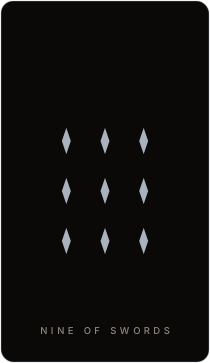
Its second mercy is geometry, and this is where the card does its work: look at where the swords are. Nine of them — the suit's near-maximum — and every one hangs on the wall, horizontal, shelved. None touches her. The card is meticulous about this: the Nine's suffering is generated by thought about the situation, not by the situation, which is elsewhere, asleep, keeping its actual dimensions. This is not a dismissal — thought-suffering is real suffering; the body cannot tell a rehearsed disaster from an occurring one, which is precisely the problem. But it is a jurisdiction ruling: the battle happening at this hour is happening in exactly one location, and that location is also where the armistice gets signed.
The quilt is the card's third statement, easy to miss in the dark: roses and zodiac signs — comfort and cosmos, the warm and the vast — covering her legs the entire time. The resources are present and unfelt: the people who would come if called, the track record of survived nights, the actual okayness of the actual moment (a bed, a roof, a body intact). The night-mind's signature move is not inventing threats; it is deleting assets. Every 3 a.m. calculation is run against an inventory of zero, which is why every 3 a.m. calculation concludes in ruin. The card does not ask you to feel the quilt — that is beyond the hour's power. It asks you to know, as a fact held against the feeling, that the quilt is there.
And its counsel is the night-veteran's protocol, unglamorous and tested. Do not adjudicate anything at this hour: the night has no jurisdiction over decisions; everything it rules on gets appealed at dawn anyway. Write the fears down — the page holds them so the loop doesn't have to; and the same catastrophes that command the dark look, on morning paper, embarrassingly mortal. And if the nights are many: the card ends its tenancy fastest when spoken — to the friend, the doctor, the professional the daylight self keeps not calling. The swords on the wall multiply in silence and audit poorly. Nine is a lot. It is also, the card notes, not ten — and the difference between this card and the next one is that nothing here has actually happened.
At work
The 3 a.m. audit of the career, run against an inventory of zero assets — no verdicts at this hour. Write it down; read it at ten; watch it shrink on daylight paper.
In love
The rehearsed disaster beside a sleeping person who'd answer if woken — the night deletes the quilt. Say the fear out loud tomorrow; spoken swords stop multiplying.
In you
Real suffering, wrong jurisdiction: the swords hang on the wall, not in you. The night has no authority over decisions — everything it rules gets appealed at dawn.
Note: Not the disaster itself — nothing in this card has happened. And not weakness: the body can't tell rehearsed ruin from real. That's the mechanism, not a verdict on you.
Reversed
Nine of Swords reversed meaning
The night-loop breaking — perspective returning with light, fears named and audited down to size, the call for help finally made. Recovery of proportion. Or, occasionally: the dread was accurate, and the work now belongs to grief, not anxiety — different tools, cleaner pain.
Reversed, the Nine of Swords is the night ending — usually in the good way, occasionally in the true way, and the card covers both with the same steadiness.
The good way is proportion returning. Light enters; the swords become wall decor; the catastrophes of 3 a.m. submit to daylight's audit and are marked down, most of them, to their actual prices: the awkward email, the finite shortfall, the checkup worth booking. The card's counsel here is to complete the audit rather than merely feel relieved — because unaudited night-fears return the next night with their inflation intact. Take the morning hour: read what the dark dictated, answer each item in daylight ink (what is actually true, what is actually likely, what is actually mine to do this week), and file it. This is not busywork; it is jurisprudence — every fear formally overruled at dawn loses standing at midnight, and the night-court, denied precedent, gradually thins its docket. The reversal often also marks the braver dawn act: the help finally called. The sentence I'm not okay at night, said to a person licensed — by friendship or by profession — to hear it, ends more Nine-of-Swords tenancies than any insight ever has. Insomnia's fears are social creatures that pose as solitary ones: they multiply in the sealed room and die of exposure to a second voice.
The true way must be included, because the card is honest and sometimes the night was too: occasionally the dread checks out. The call comes; the result is positive; the fear that rehearsed for weeks takes the stage. Here the reversed Nine performs its strangest service — it hands you off, and the handoff is genuinely a mercy. Anxiety and grief are different economies: anxiety is expensive because it is unresolved, a payment made nightly against a debt of unknown size; grief is cheaper per unit of pain because it is about something, has a shape, can be walked through and shared and finished. Readers who have lived it report the paradox reliably: the confirmed disaster often hurts less than its rehearsal, because reality arrives with edges, and edges — as this suit has said from the ace — can be held. If the fear came true: you are done with this card. Its swords hang on the wall of a room you no longer occupy. What is needed now is the Three's rain, the Five of Cups' honest mourning, the Six's boat — cleaner tools for cleaner pain. The night lied about most things. Grieve the one thing it was right about, in daylight, with the quilt — look — still on the bed.
At work
Morning jurisprudence: answer each night-fear in daylight ink — true? likely? mine to do this week? Overruled fears lose standing at midnight.
In love
"I'm not okay at night," said to one licensed listener — night-fears are social creatures posing as solitary; they die of exposure to a second voice.
In you
If the dread proved true: the handoff is a mercy. Confirmed pain has edges; rehearsed pain has none. Grief is cheaper per unit than anxiety — and finishable.
Note: Not relief as the end of the work — unaudited fears return with inflation intact. And the true fear doesn't validate the night: it lied about the rest.