Minor Arcana · Swords · Number 14
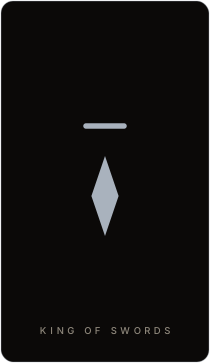
King of Swords
The mind at the head of the table — impartial, systematic, done deliberating. The fair ruling, the clear standard, the decision that can be explained. Authority earned by applying the rule to oneself first. Consult the head; let the heart testify; then decide, out loud, with reasons.
the judge's bench, the mind in office, the standard applied evenly, feeling heard as testimony, the verdict with reasons, authority as restraint
Upright
King of Swords upright meaning
The suit that began with a hand seizing a blade ends its court at a bench: the King of Swords is the mind in office. Page studied the sword, Knight rode it, Queen survived into it — the King has been given jurisdiction, and the card's first fact is the direction of his gaze. Alone in the suit, he looks straight out at you, because judgment, unlike insight, is a public act: rulings must be delivered to faces, with reasons attached, and stand up to being read back later. Wherever this card lands, something is asking to be decided properly — not felt through, not charged at, not merely seen clearly, but ruled on, in the open, by a standard that was announced before the case began.
His authority has one source, and the card is strict about it: the standard applied evenly, starting at home. The King of Swords is the figure who holds himself to the rule before extending it — who recuses where interested, shows the work behind the verdict, and can be appealed without punishing the appellant. This is rarer than competence and more valuable: rooms full of clever people are common; rooms where the clever people are also fair are where anything durable gets built. The one-degree tilt of his blade is the deck's smallest, best joke about certainty — even this sword leans, a single degree, off absolute. A judge with no tilt at all is not principled. He is finished listening.
What the motto calls the mind ruling the feeling is a courtroom procedure, not an execution, and the difference is the whole card. Feelings, at this bench, are not banished — they are sworn in. Testimony: heard in full, on the record, weighed. The King does not decide the anger is wrong; he decides the anger is evidence — of a boundary crossed, a fear touched, a value engaged — and then declines to hand it the gavel. This is the adult architecture the whole suit was building toward: not a mind that cannot feel (that machine exists, and the reversal owns it) but a mind that can feel at full volume and still locate the just outcome one shelf above the loudest voice in the room, including its own.
If the card is prescriptive, the docket is usually obvious: the decision you have been making by mood, repeatedly, hoping each mood would rule differently. The counsel is to convene the court you have been avoiding. Name the standard out loud before deliberating — what would I call fair if this were someone else's case? Hear every party, especially the feeling that has been shouting from the corridor precisely because it was never called to the stand. Then rule, with reasons, in writing if it matters — and accept appeals on new evidence only, not on volume. The suit of air ends here on purpose: thought, it has argued from the Ace, is a blade. The King is the discovery of what blades are for. Not victory — order. Not being right — being just, on the record, one degree short of sure.
At work
The decision made by mood, pending for months — convene the court. Announce the standard first, rule with written reasons, accept appeals on new evidence only.
In love
Feelings sworn in as testimony, not banished and not handed the gavel. "What would I call fair if this were someone else's case" — then say the ruling out loud.
In you
Apply the rule to yourself before extending it — recusal, shown work, appealable verdicts. Keep the one-degree tilt: certainty with no lean has stopped listening.
Note: Not coldness — the anger was heard in full; it just doesn't preside. And not tyranny: his authority is exactly as large as his restraint. The tilt is the proof.
Reversed
King of Swords reversed meaning
Intellect off its oath — logic deployed to end conversations rather than find truth, the verdict written first and the reasoning hired after. Feelings ruled inadmissible, then appealed as chaos. Brilliance without fairness is just a sharper unfairness. Vacate the ruling; reopen the case.
Reversed, the King of Swords keeps the intellect and breaks the oath — and the card insists on the order of operations, because it explains everything this figure does: the verdict comes first, and the reasoning is hired afterward. This is motivated reasoning with a gavel. The mind that could find the truth is instead retained by a client — the ego, the grievance, the preferred outcome — and it works brilliantly for that client: precedents located, definitions adjusted mid-case, the goalposts moved with citations. Watch for the tell that separates a thinking judge from a hired one: the thinking judge can name what evidence would change his mind. The hired one cannot, because no such evidence exists — the conclusion predates the case.
The motto's logic used as a wall is a specific domestic and professional weapon, and most people have been on one side of it or the other. It is reason deployed not to reach truth but to end contact: the calm voice that answers a hurt with a definition of the hurt; the request for evidence issued against a feeling, which — being a feeling — has none to file and is therefore dismissed; the maddening procedural win — you said always, and I can show one exception — that leaves the other person technically defeated and entirely unheard. The wall's genius is that it photographs as virtue: he never even raised his voice. But the volume was never the question. A courtroom where one party writes the rules of evidence is not calm. It is rigged, quietly, which is the worst way.
At institutional scale the reversal is the clever contract, the loophole lived in, the policy applied with full force downward and full flexibility upward — intelligence serving power and calling itself neutral. The card's coldest observation: nobody is more dangerous than the smartest person in the room once fairness has been made optional, because every instrument stays sharp and only the oath is gone. Unjust brilliance does not read as evil from inside. It reads as winning.
The way back runs through the one act the hired mind cannot fake: the ruling vacated at cost. Not the apology in the abstract — the specific reversal, on the record, when the evidence went against your side: I argued it because I wanted it; the reasoning came second; the ruling is withdrawn. For the walled version, the act is smaller and harder: one conversation where the feeling across the table is admitted as evidence without a competency hearing — it hurt you; that stands; I withdraw the cross-examination. The blade is not the problem; it never is, in this suit. The question the whole court asks, from Page to King, is the same one it opened with at the Ace, now with jurisdiction attached: not how sharp — in whose service. Answer it under oath this time.
At work
The reasoning was hired after the verdict — the tell: name what evidence would change your mind. If nothing could, you're not judging; you're representing a client.
In love
The calm procedural win that leaves them technically defeated and entirely unheard — volume was never the question. Admit the feeling as evidence; withdraw the cross.
In you
Vacate one ruling at cost, on the record: "I argued it because I wanted it." That's the single act the hired mind can't fake, and the oath comes back with it.
Note: Not intelligence gone bad — intelligence gone retained; the instruments are fine, the oath is off. And not calm: a rigged courtroom photographs as calm. Check who writes the rules of evidence.